
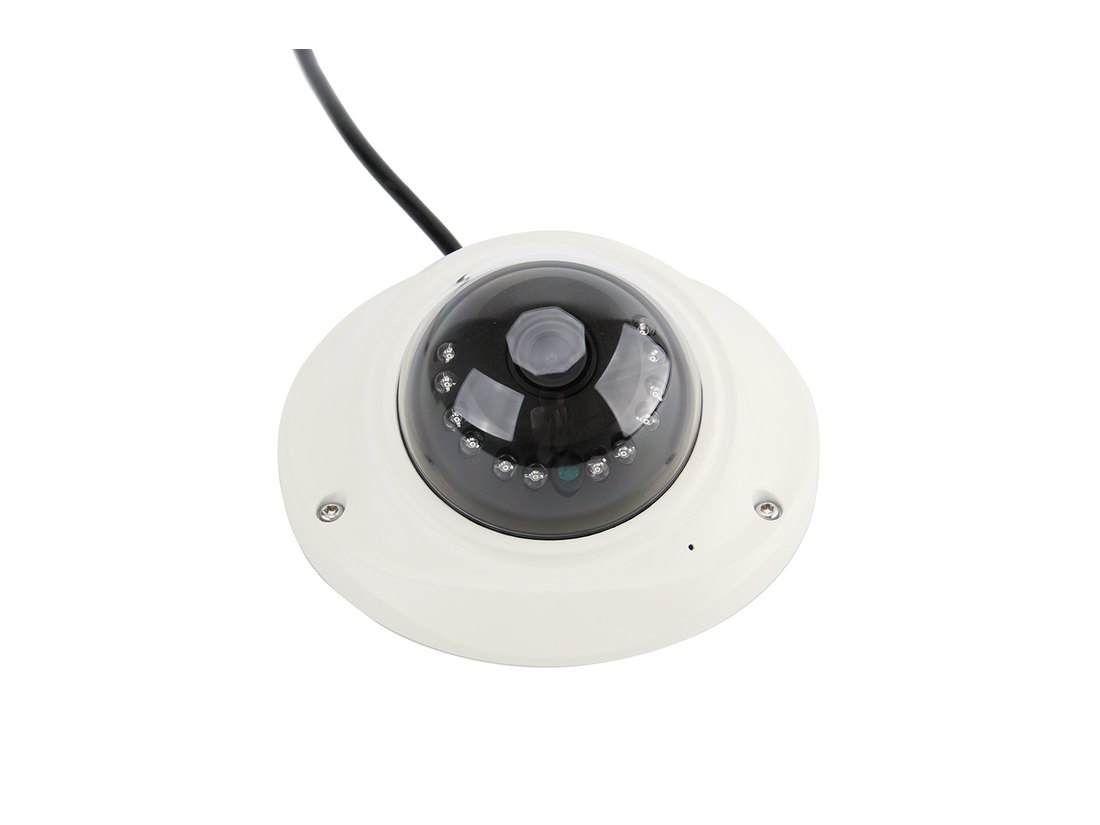
A 360° surround-view system (AVM — Around View Monitor) gives the driver one top-down image of the vehicle and everything around it, as if hovering above. There is no camera in the sky: the view is computed, in real time, from four ultra-wide cameras mounted on the vehicle’s perimeter. Understanding how it’s built explains what separates a system drivers trust from one they ignore.
Step 1: capture — four fisheye cameras
Cameras sit at the front, rear and both sides (typically in or below the mirrors), each with a fisheye lens covering roughly 180°. Between them they see everything around the vehicle — but each raw feed is heavily curved and useless for judging distance as-is.
Step 2: distortion correction
Every fisheye lens bends the world in a mathematically predictable way. Using the lens’s calibration profile, the system remaps each frame so straight lines become straight again — the same street, now geometrically faithful.
Step 3: perspective transformation
Each corrected image is then re-projected as if viewed from above. Four ground-plane views result: one per side of the vehicle. This is where accurate mounting geometry matters — the transformation depends on knowing each camera’s exact height and angle.
Step 4: stitching and blending
The four top-down views overlap at the vehicle’s corners. The system aligns the overlaps, blends brightness and colour across the seams (two cameras rarely see identical lighting), and composites a vehicle graphic in the centre. Done well, the result reads as a single continuous image; done poorly, obstacles can distort or vanish exactly at the corners — the highest-risk zones.
Why calibration decides everything
Calibration ties all four steps to the physical truth of one specific vehicle. It is performed after installation by laying patterned mats around the vehicle; the system detects the patterns and solves for each camera’s true position and angle. JMK systems automate this — typical calibration completes in under a minute, which matters when an installer is fitting a whole fleet.
Poor calibration shows up as misaligned seams, “bent” kerbs, and distance errors. If drivers can’t trust the geometry, they stop using the screen. Calibration quality is, in a real sense, the product.
2D, 3D and what AI adds
Modern systems offer the classic top-down 2D view plus a 3D mode that orbits the vehicle — useful for checking high loads or trailer swing. Layered on top, AI detection (pedestrian and obstacle recognition, moving-object alerts) turns the surround view from a passive picture into an active safety system: the screen shows and warns.
What to evaluate in a system
- Seam quality at the corners, in daylight and at night
- Calibration time and whether it needs specialist staff
- Latency — the image must track manoeuvres in real time (see our AHD vs IP guide)
- Detection: is AI object detection available in the danger zones?
- Durability of the cameras themselves — IP69K sealing for washdown fleets
Ask us for a demonstration unit to evaluate stitching quality on your own vehicle type.