
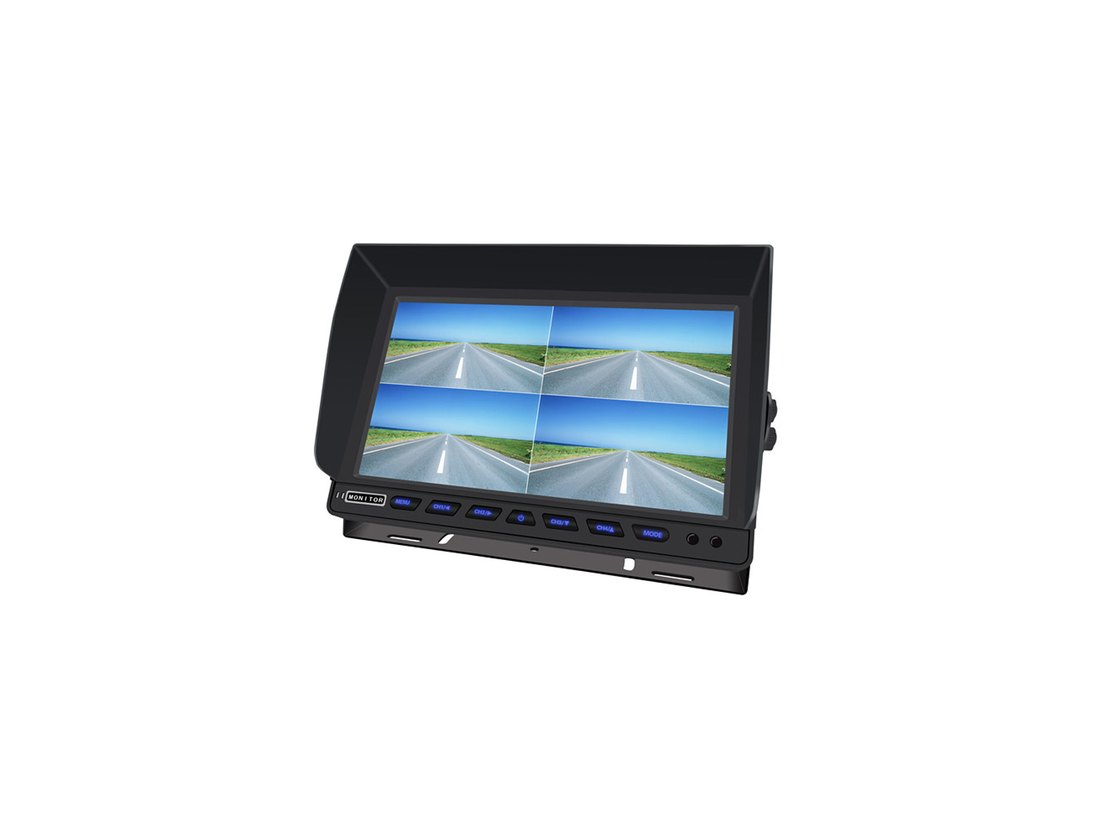
Both AHD and IP cameras can deliver sharp, high-definition video on a vehicle. The right choice depends on what the video is for: a driver reacting in real time, or a system recording and analysing footage. This guide sets out the practical trade-offs we walk distributors through when specifying a system.
How AHD works
AHD (Analog High Definition) transmits uncompressed HD video as an analog signal over simple coaxial or 4-pin aviation cable. There is no encoding step between the sensor and the monitor, which gives AHD its defining property: near-zero latency. The image the driver sees is effectively live.
- Resolution: 720P and 1080P are standard across the industry
- Latency: typically well under 50 ms glass-to-glass
- Cabling: coax / aviation connectors — robust, cheap, easy to repair fleet-side
- Power and signal can share one cable run, simplifying installation
How IP works
IP cameras digitise and compress video (H.264/H.265) on the camera, then send it as network data over Ethernet. That buys flexibility and higher resolution ceilings, at the cost of an encode–decode cycle on every frame.
- Resolution: scales beyond 1080P (4K and above) where the platform supports it
- Latency: encoding, network transport and decoding typically add 150–500 ms
- Cabling: Ethernet with PoE — tidy, but connectors and switches add cost and failure points in high-vibration environments
- Integrates naturally with onboard networks and telematics platforms
The decision in practice
Choose AHD when a human is reacting to the image. Reversing, manoeuvring, blind-spot monitoring and mirror-replacement views are safety-critical: a half-second of latency is the difference between stopping and not stopping. This is why AHD remains the backbone of driver-facing vehicle vision, and why regulations for camera-monitor systems emphasise image delay.
Choose IP when a machine is consuming the video. High-resolution evidence capture, ANPR, AI analytics running on a central unit, and integration with IP-based fleet platforms all favour networked cameras.
Most real fleets mix both. A typical JMK installation pairs AHD cameras for the driver’s live views with an MDVR that records all channels — and, where the application calls for it, IP cameras for high-detail evidence or analytics.
Specification checklist
Before committing to a technology, confirm:
- Who watches the feed — driver (favour AHD) or software (either)?
- What does the vehicle’s electrical environment look like — long cable runs and high vibration favour coax and aviation connectors
- Does the recorder support hybrid channels? JMK MDVRs accept AHD and IP inputs side by side, so the choice can be made per camera position rather than per vehicle
- What are the certification requirements in the target market (e.g. UNECE regulations for indirect vision) — image latency limits may effectively mandate AHD for certain views
Talk to our engineering team for a channel-by-channel recommendation for your vehicle types.